
A great university is defined by great minds, not great buildings — that is the consensus. But for university administrators, raising quality depends not only on faculty and disciplines, but increasingly on the precision of campus operations and the strength of service support. Multi-campus management, aging facilities, energy pressure and rising expectations for service quality together form the real challenges of modern higher-education governance.

The Virsical Smart Campus solution uses space as the management unit and IoT plus a data platform as the technical foundation, providing higher-education institutions with a digital capability system covering campus operations, resource allocation, faculty-student services and teaching support. Dispersed subsystems are brought under one unified framework, making campus operation status visible, manageable and controllable — evidence for managers and convenience for faculty and students.
01 Technical Architecture: The Digital Foundation of Campus Operations
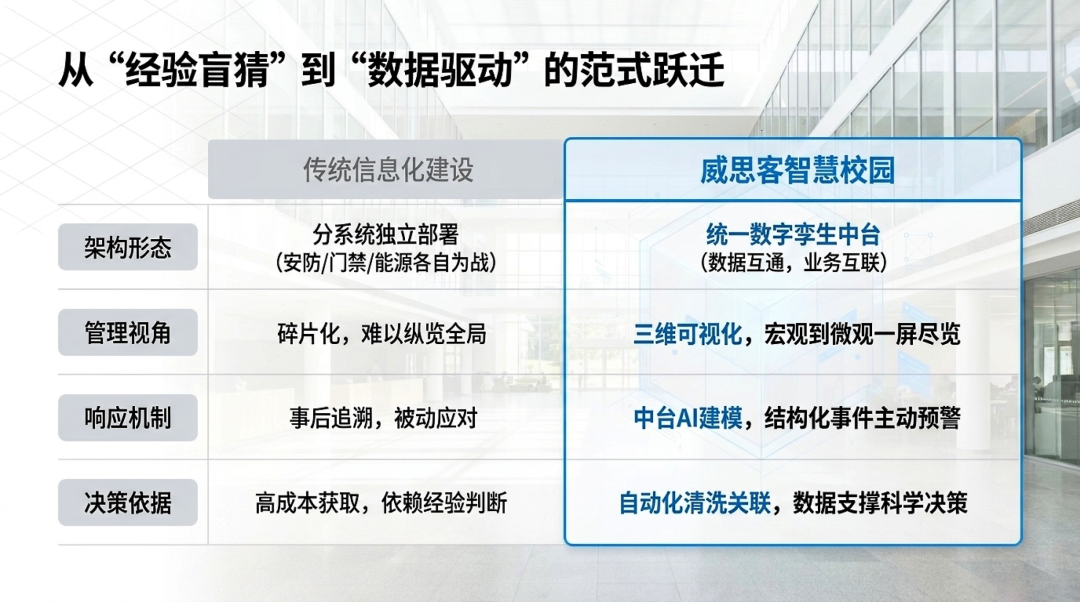
Traditional campus informatization often deploys systems independently — security, access, energy and maintenance each in their own silo, with disconnected data and processes, and no global view for managers.
Virsical takes digital twin as its core concept, 3D visualization as its signature, and IoT, big data and AI as the base, adopting a three-layer “perception – data platform – application” architecture. Digital twin mirrors campus physical space into a campus “smart brain”, giving managers a view from macro to micro.
The perception layer connects security cameras, access readers, utility meters and environmental sensors into one IoT network, continuously collecting the state of every physical space.
The data, business and AI platforms together form integration and semantic-processing capability, cleaning, correlating and modeling raw data from different subsystems. For example, when security records a person lingering in an area while access control shows no matching permission, the two signals converge into a structured alert event — turning scattered signals into business-meaningful information.
The application layer serves different roles: managers get operational metrics through dashboards, logistics staff receive tasks through work orders, and faculty and students book and report faults on mobile. The three layers form a closed data loop, giving operations systematic technical support.

02 Operations Management: From Experience to Data-Driven
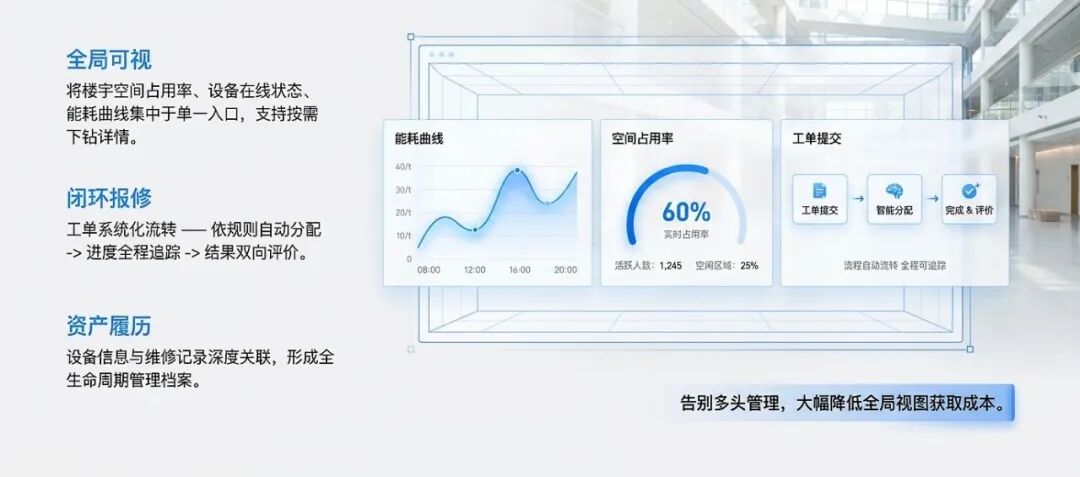
Campus management data is scattered across dozens of independent systems; getting a global view is costly and decisions lean on experience. Virsical provides a unified operations console presenting space occupancy by building, equipment online status, daily energy curves and repair trends — managers get a macro view through one entry point and can drill down as needed.
In logistics scenarios, repair work orders flow systematically: submitted, auto-assigned by preset rules, trackable, and evaluable on completion. Asset information links with maintenance records to form full-lifecycle archives. For energy, continuous monitoring of water and electricity helps logistics departments identify abnormal consumption points and supports retrofitting decisions.
03 Space & Resource Allocation: Raising Turnover of Public Resources
Auditoriums, meeting rooms, labs, sports venues and study seats commonly suffer from opaque usage, tedious booking and mismatched supply-demand. The Virsical space resource management system offers status query, online booking, approval flow and usage verification. Faculty and students see occupancy, submit bookings with automatic conflict checks, and recurring activities support periodic booking.
Labs and training rooms connect to course schedules and equipment status, prioritizing planned teaching while opening idle slots for autonomous booking. Library seats use a book-check-in-release mechanism to reduce seat-occupying. This raises space turnover and shortens waiting time, releasing usable area without new construction.
04 Campus Services: From Process Management to Convenient Experience
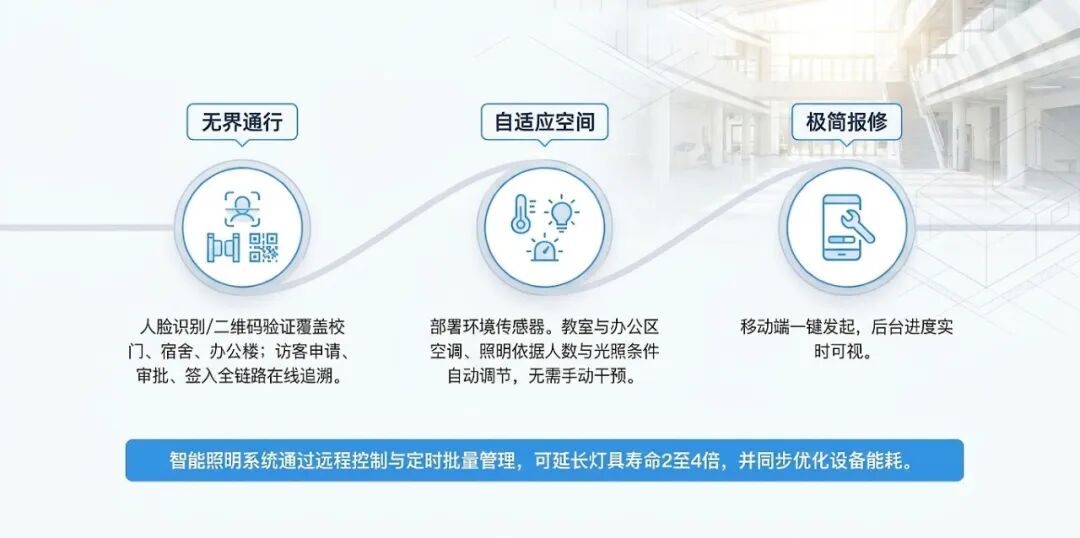
Faculty and students perceive service quality through high-frequency interactions like access, repairs and feedback. Virsical provides facial recognition or QR verification covering campus gates, dormitories and office buildings, with visitor booking fully online — application, approval, authorization and check-in/out fully traceable.
For logistics services, facility repair is online with real-time background progress. Classroom and office HVAC and lighting, once sensors are deployed, adjust automatically by headcount and light levels — comfortable conditions without manual operation. Smart lighting via remote control and scheduled batch management can extend lamp life 2–4× while optimizing energy use.
05 Security Management & Sustainable Operations
For safety and energy: video surveillance, access control and fire alarms are integrated into one unified event-response framework, shortening the time from incident to response.
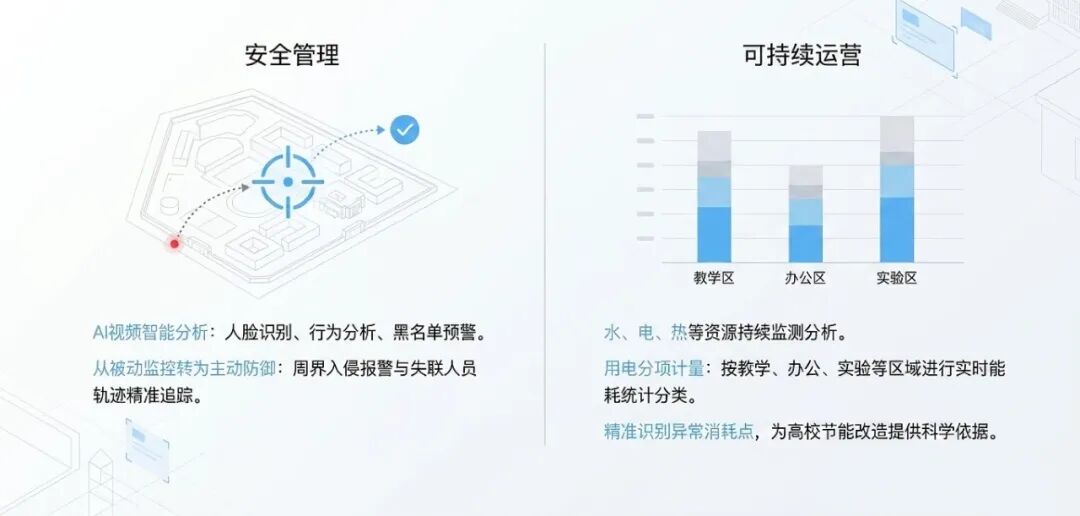
The AI analysis module uses facial recognition, behavior analysis and trajectory query to deliver blacklist alerts, perimeter intrusion alarms and missing-person trajectory tracking — turning passive monitoring into proactive warning.
Under integrated security-fire linkage, when a fire occurs the system automatically opens evacuation routes through access control and gates, ensuring fast, safe evacuation.
Energy monitoring and smart control support continuous analysis of water, electricity and heat; itemized electricity metering provides real-time consumption statistics by teaching, office and lab area, helping universities advance energy optimization without disrupting teaching and research.
The Virsical Smart Campus solution treats campus space as a visible, manageable, controllable resource system, using digital twin technology to raise operational efficiency and service quality. It integrates flexibly with existing campus infrastructure and deploys modularly according to each institution’s scale and needs.
From implemented projects, the solution delivers verifiable results in operational efficiency, resource utilization and service experience. Universities with needs are welcome to contact us to discuss a smart campus plan suited to their own characteristics.
Contact us to learn more — Virsical Smart Campus supports the digital transformation of higher education.